Six matchsticks in a square
No simple loop of six unit sticks fits in a unit square: the six-stick case of an open parity question.
Partial progress on an open problem
Six unit sticks and the diameter of a hexagon
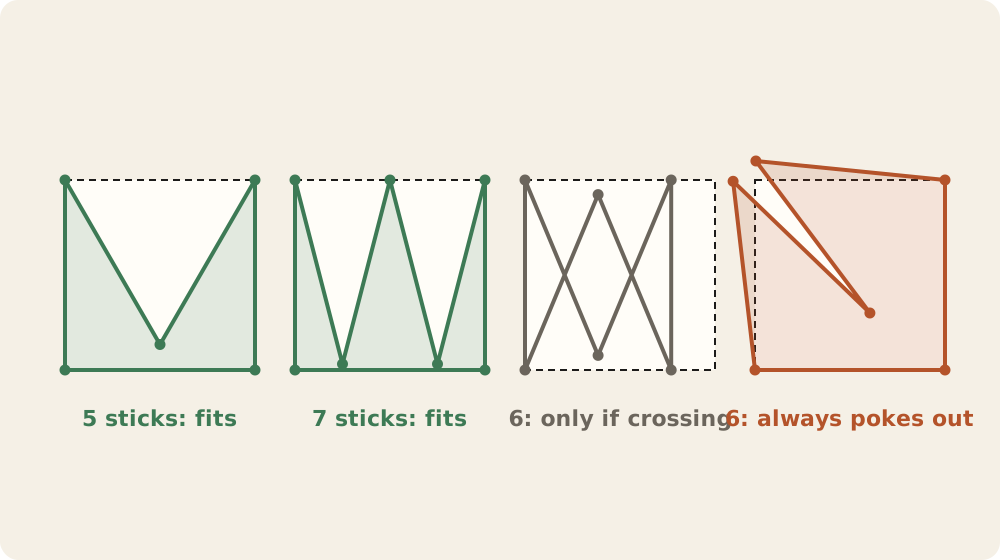
Join six sticks of length one, end to end, into a closed loop that does not cross itself. JetfiRex asked on MathOverflow (question 481323) and Mathematics Stack Exchange (question 4987974) whether every simple unit polygon in the closed unit square, other than the square itself, must have an odd number of sides. Pentagons and heptagons fit; even numbers seem not to.
Every simple unit hexagon has diameter greater than √2, the constant is sharp, and it is never attained (Theorem 1). So no simple unit hexagon fits in a closed unit square or a closed disk of radius 1/√2, while one fits in any larger square or disk (Corollary 1). This settles the six-sided case of the question. For octagons, the two-reflex case is reduced to a single configuration (Proposition 2); eight or more sides remain open.
Preprint v1, 9 October 2026, not peer reviewed. The lemmas, the triangle proposition, the angle counting, the sign lemmas of the case analysis and every claim about the sharpness family are formally verified in Lean 4 (lean/, standard axioms only). The Jordan-curve facts about hull pockets and the passage from a polygon to these configurations are checked by hand; lean/README.md lists exactly what is and is not formalised. The author used AI tools (Codex, OpenAI; Claude, Anthropic) in this work, as described in the paper’s acknowledgement, and is responsible for its content.