Two triangulations, one outline
From nine points on, two triangulations can share nothing but the five outline edges, answering Rote.
Open problem settled, formally verified in Lean 4
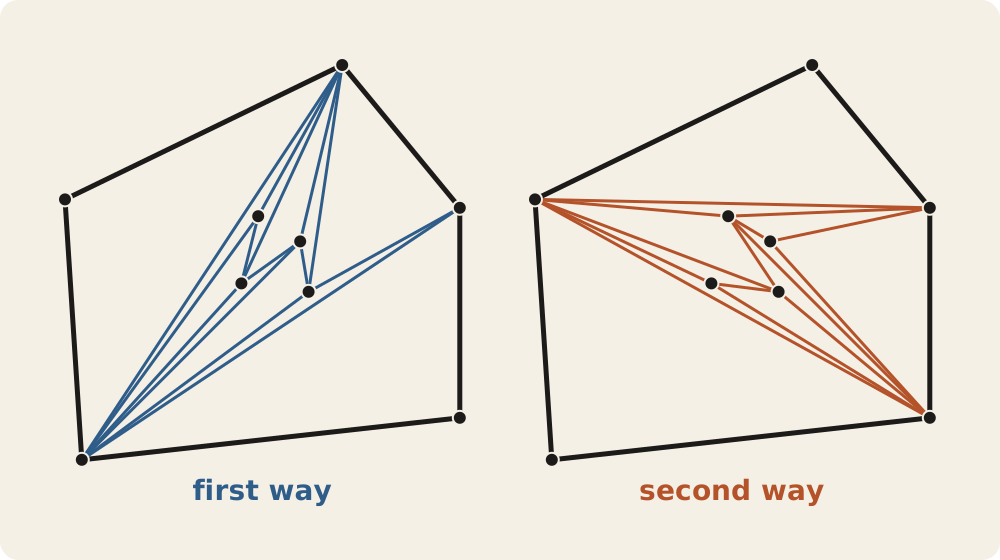
Two triangulations that share only their hull
Any two triangulations of a finite point set in the plane contain the edges of its convex hull. How few other edges must they share? For every n ≥ 9 there are n points in general position, with a pentagonal hull, whose two triangulations share nothing else; since five edges must always be shared once n ≥ 5, the minimum is exactly five. The construction starts from nine explicit points and inserts points one at a time, carrying along a chain (a face of one triangulation whose side passes through two suitable faces of the other) that makes the next insertion possible.
Started from a convex polygon, the same construction settles every hull size: n points with h hull vertices admit two triangulations sharing only the hull exactly when n = h, or h ≥ 6, or h = 5 and n ≥ 9. The cases of a pentagonal hull with six to eight points rest on an exhaustive search over the order-type database of Aichholzer, Aurenhammer and Krasser.
The question is from MathOverflow (question 454425). The nine-point example and the pentagonal case were first posted as the author’s MathOverflow answer on 30 September 2026, with certificates in triangulations-sharing-five-edges.
Preprint, 8 October 2026. The author used AI tools (Claude, and ChatGPT for a later revision) in developing the proofs, code and text, as the paper’s acknowledgements describe, and takes full responsibility for its content.