Counting cycles in a Sylow 2-subgroup
The two factors Stanley observed are irreducible over the rationals at every level.
Open problem settled, formally verified in Lean 4
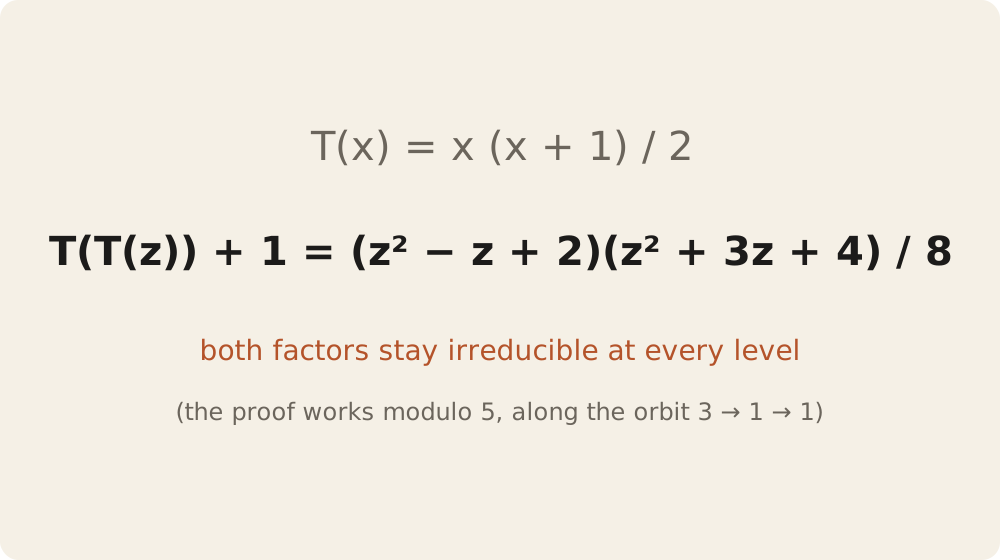
Count the permutations in a Sylow 2-subgroup of the symmetric group on 2^n points by their number of cycles. Richard Stanley observed on MathOverflow (question 489315) that a closely related polynomial, after adding a power of 2, splits into two factors of equal degree that appear to be irreducible. Darij Grinberg and Max Alekseyev proved the factorization there; irreducibility was left open.
Both factors are irreducible over Q for every n (Theorem 1 and its corollary). The recurrence printed in the question is one index off from the Sylow polynomials. The paper treats both families, and the same proof covers each. After scaling, both are iterates of the triangular-number map T(x) = x(x+1)/2. The factorization is a difference of two squares, T(T(z)) + 1 = (z² − z + 2)(z² + 3z + 4)/8. Irreducibility follows modulo 5: the critical orbit of T there is 3 → 1 → 1, both factors take non-square values along it, and the quadratic case of Capelli’s lemma applies at every step. The analogous question for odd primes stays open; the paper reduces it to iterates of (x^p + (p−1)x)/p and records small cases.
Preprint v1, 9 October 2026, not peer reviewed. Every algebraic statement (the composition lemma with its norm computation, both factorizations, the coefficient agreement, irreducibility over F_5, Z and Q for every n) is formally verified in Lean 4 (lean/, standard axioms only). The identification of the recurrence with the cycle count is the classical wreath-product formula, proved in the paper and checked by listing the group for n ≤ 4. The author used AI tools (Codex, OpenAI; Claude, Anthropic) in this work, as described in the paper’s acknowledgement, and is responsible for its content.