697 × 611 in fourteen squares
The rectangle needs exactly fourteen squares, not seventeen, so it is not a counterexample to the minimal squaring conjecture.
Open problem settled, verified by computation
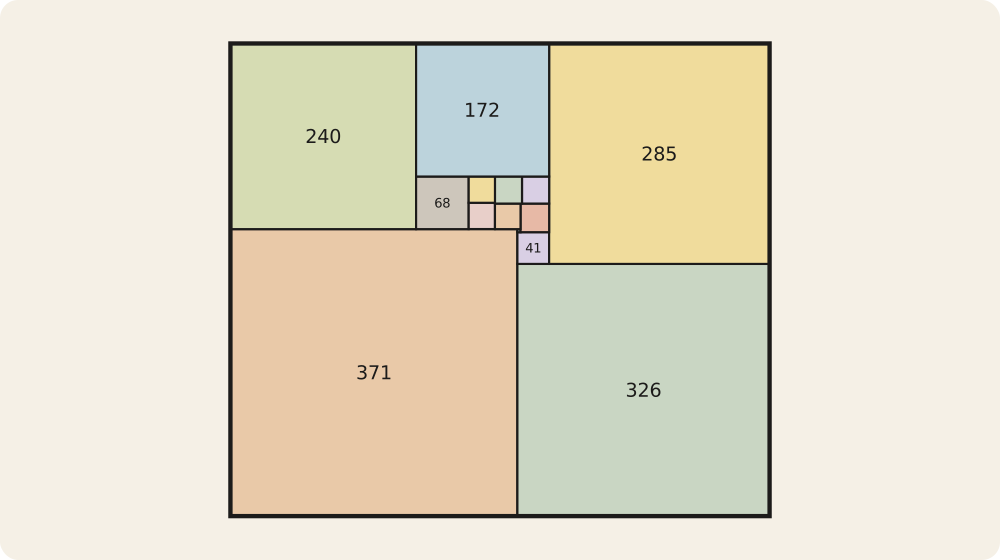
The 697 × 611 rectangle needs exactly fourteen squares
Write f(m, n) for the least number of integer-sided squares that tile an m × n rectangle. Scaling a tiling shows f(tm, tn) ≤ f(m, n), and the minimal squaring conjecture says equality always holds. Answering the MathOverflow question Tiling a rectangle with the smallest number of squares, Ed Pegg Jr reported in 2017 that one possible counterexample remained among rectangles with sides at most 760: 697 × 611, whose best known tiling used 17 squares, while 1394 × 1222 could be tiled with 16.
The note shows f(697, 611) = 14 (Theorem 1). The fourteen squares have sides 371, 326, 285, 240, 172, 68, 41, 37, 35, 35, 34, 34, 33 and 4; the tiling is compound and uses equal squares, so catalogues of simple perfect squared rectangles miss it. The lower bound is a complete enumeration of squared rectangles with at most 13 squares through the electrical networks of Brooks, Smith, Stone and Tutte, generated as quadrangulations by plantri. The same enumeration reproduces every value of OEIS A219158 (all sides up to 388) that is at most 14. So 697 × 611 is not a counterexample, and 1394 × 1222 also needs at most 14 squares.
Preprint v1, 9 October 2026, not peer reviewed. The tiling was first posted as a MathOverflow answer on 29 September 2026, with a picture in minimal-squaring-697x611; the lower bound is new here. Computer-certified: the lower bound rests on an exhaustive search, checked against the OEIS table and by a mutation test, with no Lean formalisation. The author used an AI tool (Claude, Anthropic) in this work, as described in the note, and is responsible for its content.