The chain that reaches farthest
Every best chain has lengths rising then falling; exactly three orders occur for four segments, and the general count is open.
Partial progress on an open problem
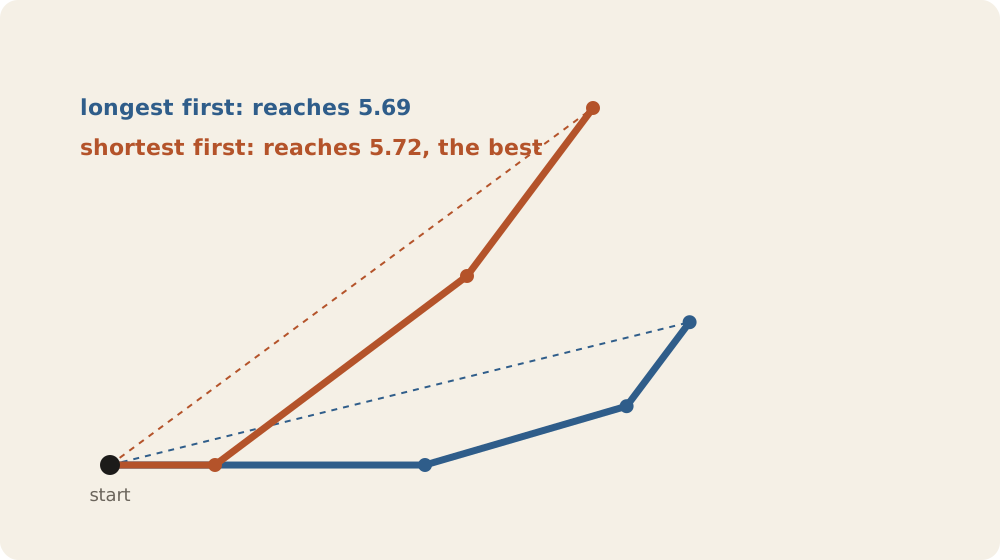
Which orders maximise the span of a chain?
A planar chain has segments of given distinct lengths, each turning anticlockwise by one of given distinct angles; lengths and angles can be used in any order. Which orders put the end farthest from the start? Arthur Queiroz Moura asked on MathOverflow (question 442949), attributing the problem to Ronaldo Garcia, how many relative orders a_n can be optimal when the angles total at most π/2.
When the angles total less than π, every optimal chain has strictly unimodal lengths with the two shortest at the ends, turns that fall and then rise, and its longest segment at the smallest turn (Theorem 1), confirming observations of Claude Chaunier; this gives an O(n² log n 2ⁿ) algorithm (Theorem 2). Exactly three orders occur for four segments (a₄ = 3), and an explicit recursive family shows a_n ≥ b_n for every n, where b_n = 1, 3, 6, 14, 31, 70, 157, … is OEIS A006356 (Theorems 3 and 4); in particular a₇ ≥ 31, two more than the list in the question. Equality a_n = b_n is conjectured and open.
Preprint v1, 8 October 2026, not peer reviewed. Theorem 1 and a₄ = 3 are formally verified in Lean 4 (lean/, standard axioms only). The realisation theorem has a hand proof; it and every numerical claim are checked by exact programs, two of them written independently. The author used AI tools (Codex, OpenAI; Claude, Anthropic) in this work, as described in the paper’s acknowledgement, and is responsible for its content.