Does the smallest copy fit?
For many random points in an equilateral triangle, the smallest enclosing copy fits inside with probability tending to 13/48, not 1/2.
Open problem settled, formally verified in Lean 4
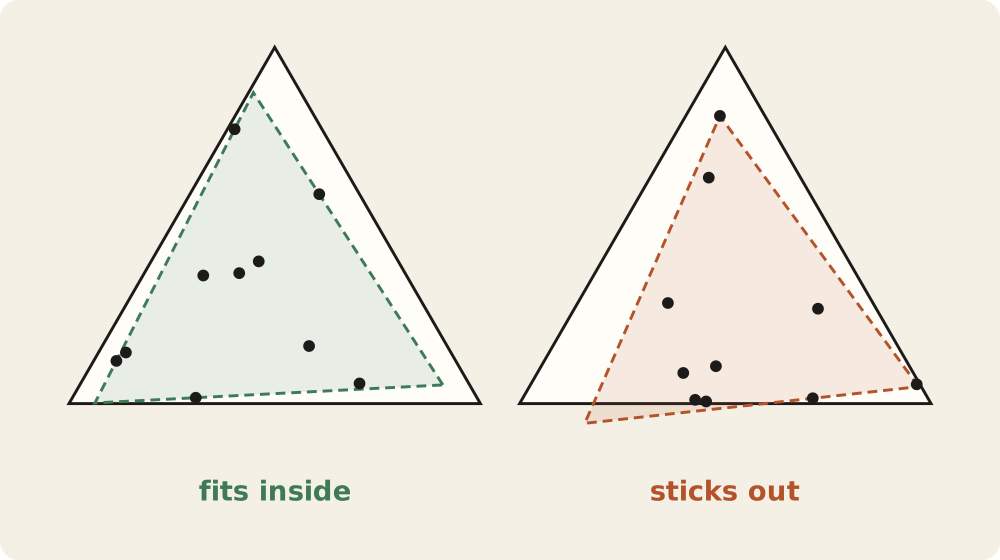
Does the smallest enclosing copy fit? Random points in a convex polygon
Drop n random points into a disk and draw the smallest circle containing them: does it lie inside the disk? An answer on Mathematics Stack Exchange shows that the limiting probability is 1/2 (question 4799757). A follow-up on MathOverflow asked whether the same holds for a regular polygon and a smallest enclosing regular polygon, which may be rotated (question 458571).
The answer is no. For n uniform points in a convex polygon K, the probability that some smallest similar copy of K containing them lies inside K converges to an explicit constant p(K), given by a formula over a Poisson limit model (Theorems 1 and 10). For triangles the formula is explicit (Corollary 2): p = 13/48 for the equilateral triangle, 7/24 for the right isosceles triangle, 29/96 for the 30-60-90 triangle. For the regular q-gon (Corollary 3),
p_q = q tan(π/q) E[Vol(T) 1{0 ∈ int T}] + 1{q even} 8/(3q²),
where T is the tetrahedron spanned by four independent points, each on a uniformly chosen vertical edge of the prism P_q × [-1, 1] at a uniform height; p_4 = 1/4, and numerically p_q settles near 0.146, far from the disk’s 1/2. The reason is the freedom to rotate the enclosing copy, which the disk does not have.
Preprint v1, 8 October 2026, not peer reviewed. Every theorem, lemma and corollary is formally verified in Lean 4 (lean/, standard axioms only); the exposition has not yet been independently reviewed. The author used AI tools (Claude, Anthropic; Codex, OpenAI) in this work, as described in the paper’s acknowledgement, and is responsible for its content.