Sixteen words cover all 15-bit strings
Deleting five bits from every 15-bit string can leave just 16 different strings, down from 17 in 2013, so the growth rate of the n/3-deletion problem is at most 16^(1/15) < 1.2031; among symmetric sets 16 is optimal.
Partial progress on an open problem
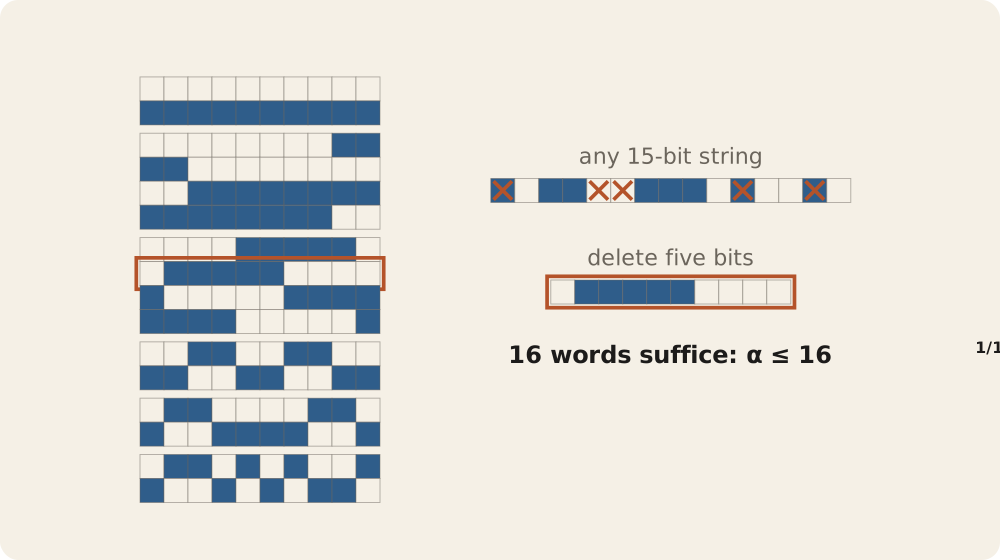
From every binary string of length n = 3k delete k bits, choosing the deletions so that as few distinct strings of length 2k remain as possible (MathOverflow 142857, 2013). The least number H(3k, k) grows like α^(3k); the 2013 discussion showed α exists (blocks and Fekete’s lemma), bounded it below by 2^(5/3)/3 ≈ 1.058, and above by small covers, the best being a 17-word cover for n = 15: α ≤ 17^(1/15) ≈ 1.2079.
Theorem. These sixteen strings of length 10 cover length 15 (every 15-bit string contains one as a subsequence), and none can be dropped:
0000000000 0000000011 0000111110 0011001100 0011111111 0110000110 0110101001 0111110000
1000001111 1001010110 1001111001 1100000000 1100110011 1111000001 1111111100 1111111111
So H(15,5) ≤ 16 and α ≤ 16^(1/15) < 1.2031. The set is closed under complement and reversal, and no such symmetric set of 15 or fewer strings covers length 15: found by CP-SAT, confirmed by Glucose on an independent encoding, whose DRAT proof of unsatisfiability is checked by drat-trim. Whether an asymmetric 15-word cover exists is open.
Preprint v1, 10 October 2026, not peer reviewed and not yet independently reviewed. The block argument, the submultiplicativity of H, Fekete’s limit and the bound on α from a 16-word cover are formally verified in Lean 4 (lean/, standard axioms only); the cover itself and the symmetric optimum are finite computations checked by independent programs and a proof checker. The author used AI tools (Claude, Anthropic) in this work, as described in the paper’s acknowledgement, and is responsible for its content.