Necklaces no cut can split
Shuffle anti-squares exist in every even length from 24, as Grytczuk, Pawlik and Pleszczyński conjectured.
Open problem settled, formally verified in Lean 4
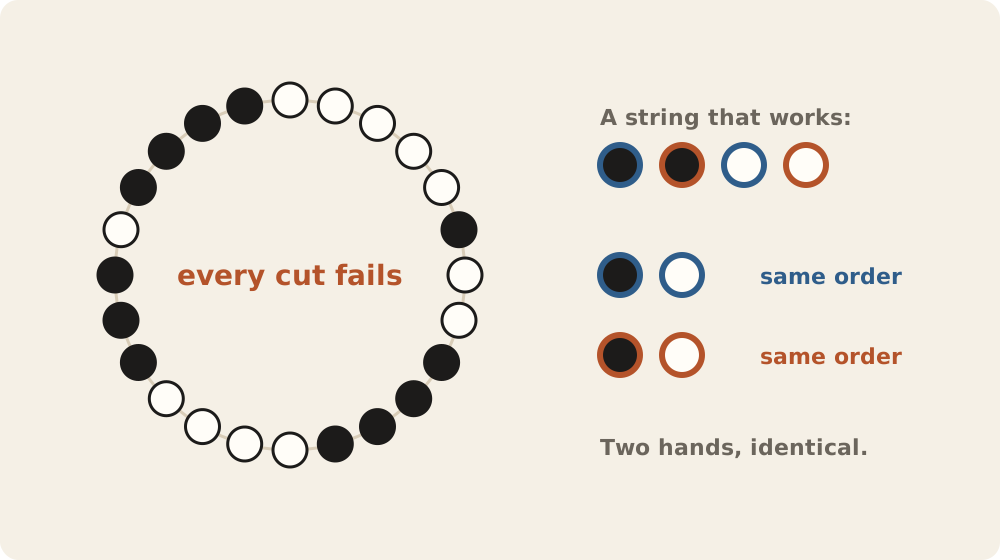
Shuffle anti-squares of every even length from 24
A binary word is a shuffle square if its letters can be coloured with two colours so that each colour, read in order, spells the same word: 1100 is one (both copies spell 10), 0110 is not. An even word, with an even number of each letter, is a shuffle anti-square if none of its cyclic rotations is a shuffle square. Grytczuk, Pawlik and Pleszczyński found that the shortest anti-squares have length 24 and conjectured that they exist in every even length from 24 upward (arXiv:2308.13882, Conjecture 1).
The paper proves the conjecture with two explicit families,
U_k = 0^(k+9) 1 0^5 11 0^(k+9) 1 0^2 1 0 111(length 2k + 34), with a short proof by hand, andW_k = 0^(k+5) 1 0^2 1111 0^(k+4) 111 0 1111(length 2k + 24),
and extends the first: multiplying every zero run of U_k by any λ and replacing every one by a block of μ ones, μ odd, still gives an anti-square (Theorem 4; both conditions are needed). Since one cut can only rotate a word, it follows that some even word of every length from 24 needs two cuts before its pieces can be rearranged into a shuffle square (Corollary 6). Grytczuk, Pawlik and Ruciński had found such a word of length 24 and conjectured that two cuts always suffice (arXiv:2503.22043, Section 6.3); a computer check confirms this for every anti-square up to length 34.
Preprint, 8 October 2026. The author used AI tools (Claude, Anthropic) in this work, as described in the paper’s acknowledgements, and takes full responsibility for its content.