A randomized Pascal triangle
The expected average blows up whenever p ≥ 0.232; whether it does for every p > 0 is open.
Partial progress on an open problem
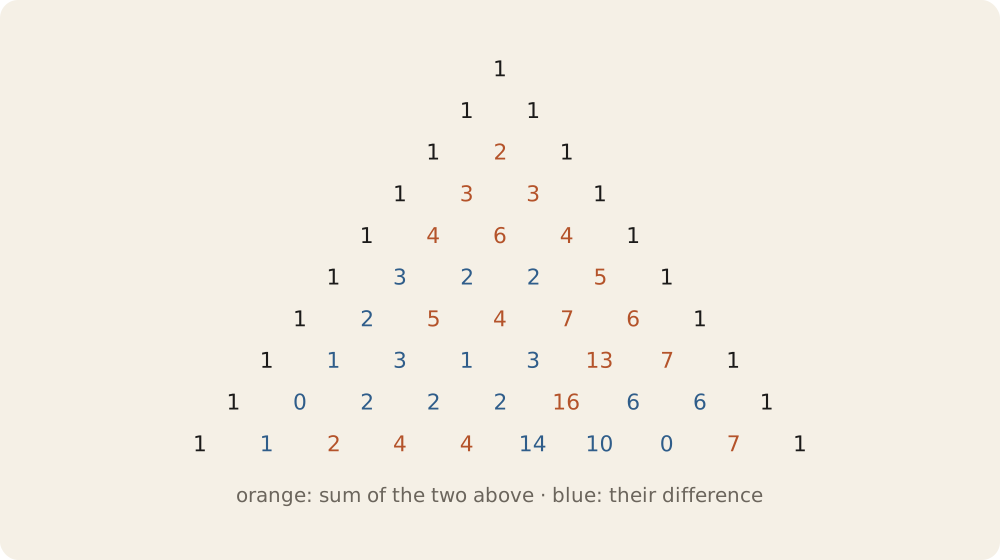
A randomized Pascal triangle whose average blows up
Build Pascal’s triangle, but let each interior entry be the sum of the two entries above it with probability p and their absolute difference otherwise. Does the expected average of all the entries tend to infinity? The question was asked on Mathematics Stack Exchange (question 4972093) and MathOverflow (question 479618); it was known for p > 1/2.
The expected sum of row n is at least λ(p)^n with λ(p) = p² + √(p⁴ + 4p(1 − p)), which exceeds 1 exactly when p > 1 − 1/√2 ≈ 0.293 (Theorem 1). The proof uses the row sum and the total variation of the row: the sum grows only when the row is rough, and coins that disagree keep it rough. A computer-assisted extension of the same idea, with an exact certificate, gives growth for p ≥ 29/125 = 0.232 (Theorem 2). In both ranges the expected average tends to infinity. Whether it stays finite for any p > 0 is open; simulations by Einar Rødland on the Stack Exchange thread suggest it diverges for every p > 0.
Preprint v2, 9 October 2026, not peer reviewed (v1, 8 October 2026, verified Theorem 2 in Lean only relative to the certificate). Both theorems and the corollary are formally verified in Lean 4 (lean/, standard axioms only), including the local inequality behind Theorem 2: Lean checks the certificate on each of the 688 sign regions of its hyperplane arrangement. The certificate is also checked by two programs that share no code. The author used AI tools (Codex, OpenAI; Claude, Anthropic) in this work, as described in the paper’s acknowledgement, and is responsible for its content.