Raising the apex raises the Gaussian centroid
Raise a triangle's apex along the perpendicular through a point of its base and the Gaussian centre of mass rises, in every dimension and wherever the Gaussian is centred; whether it always pins down the moving vertex is open.
Partial progress on an open problem
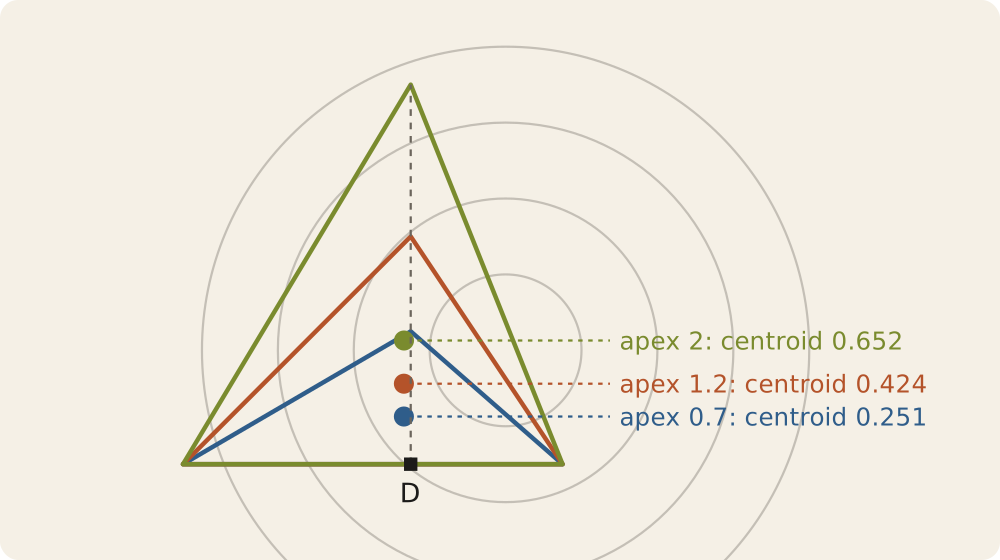
jens asked on MathOverflow (question 499635) whether the centre of mass of the standard Gaussian restricted to a triangle ABC determines C once A and B are fixed, and needs the same for n-simplices. When neither triangle contains the other a separating line settles it; the hard case is when one contains the other.
Theorem. Let K be a compact convex set with nonempty interior in a hyperplane H of ℝⁿ, D ∈ K, and T_h the convex hull of K and the apex D + hν on the normal through D. Under the standard Gaussian restricted to T_h, the mean distance from H is strictly increasing in h.
So the Gaussian centroid determines the apex on every line perpendicular to a side (or facet) through a point of it: a family of nested triangles and simplices. The Gaussian may be centred anywhere. Every horizontal slice of T_h is the base scaled about D, so the height of a Gaussian point has density w(y) F(1 − y/h) with one function F, the Gaussian mass of the scaled base. Prékopa’s theorem makes log F concave, and a concave increasing function gains more over longer, lower intervals; so the likelihood ratio between two apex heights increases, the vertical factor w cancels, and Chebyshev’s integral inequality raises the mean. Both hypotheses matter: with the foot outside the base the mean height can fall. When the apex moves obliquely the slices are no longer scaled copies about one point and the argument stops: the general question is open.
Preprint v1, 10 October 2026, not peer reviewed and not yet independently reviewed. The steps after Prékopa’s theorem (the cone lemma, the increment lemma, the monotone likelihood ratio, Chebyshev’s integral inequality with its strict form, the mean comparison) are formally verified in Lean 4 (lean/, standard axioms only); Prékopa’s theorem and the Gaussian factorisation are quoted. The author used AI tools (Claude, Anthropic) in this work, as described in the paper’s acknowledgement, and is responsible for its content.