Prime squares and half-turns
A p × p square, p prime, cut into p congruent pieces that are only translated or half-turned must be cut into bars; with quarter-turns too, the question is open.
Partial progress on an open problem
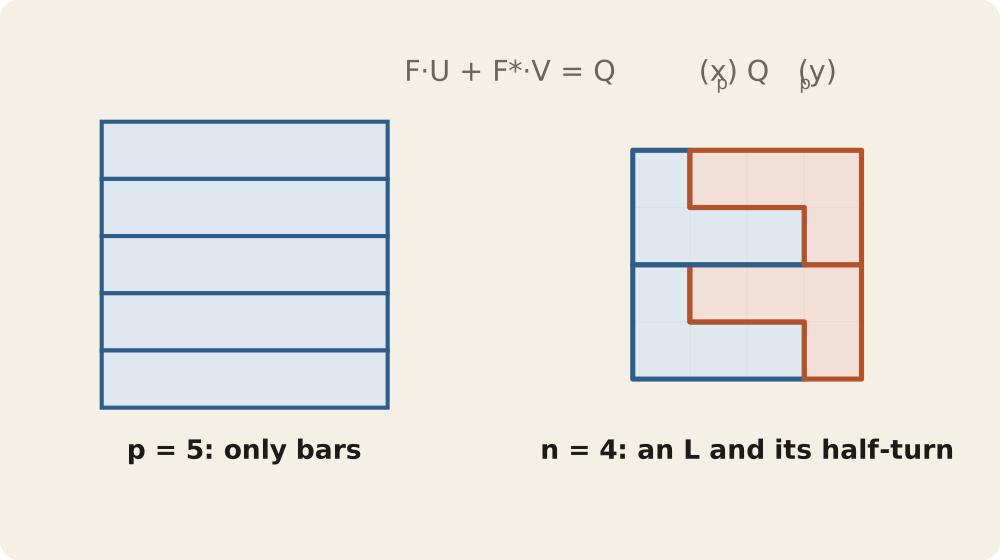
JetfiRex asked on MathOverflow (question 487157) and Mathematics Stack Exchange (question 5007342) whether a p × p square, p prime, can be cut into p congruent p-ominoes in any way other than into p straight bars. Composite sizes have other tilings (an exhaustive search finds them for every composite n ≤ 14), so any proof must use primality. The question is a discrete case of Danzer’s open conjecture on cutting a square into congruent pieces.
The note proves two restricted forms, without assuming the piece is connected:
- Theorem 1. For every prime
p, if each piece is a translate of one cell setPor of its half-turn, thenPis a straight bar. - Theorem 2. For odd
p, the same holds with the half-turn replaced by any one fixed reflection of the square. (Forp = 2it fails: two diagonal cells and their mirror image tile the2 × 2square.)
The proof encodes cells as Laurent monomials, so a tiling becomes F·U + F*·V = Q_p(x) Q_p(y) with F* the half-turn of the piece. Either F and F* share a factor, which must be one of the two cyclotomic primes of the board and forces a bar, or they are coprime, and evaluating F ∣ U* − V at (1,1) shows that only one orientation is used. With translations alone the result is close to known theorems (Szegedy; Horak and Kim) and is not claimed as new; p = 3 follows from Maltby’s classification of trisected rectangles. Quarter-turns, or two different reflections, bring in a third tile polynomial and the argument stops: the full question is open.
Preprint v1, 10 October 2026, not peer reviewed and not yet independently reviewed. The algebraic core is formally verified in Lean 4 (lean/, standard axioms only); the unique factorisation of the Laurent ring and the encoding of a tiling are quoted. The author used AI tools (Claude, Anthropic) in this work, as described in the paper’s acknowledgement, and is responsible for its content.