Deleting the powers of four
Remove 16, 64, 256, … and the ordered ways to write n as a sum of three survivors still rise at every n: Sándor and Yang's Remark 1.3.
Open problem settled, verified by computation
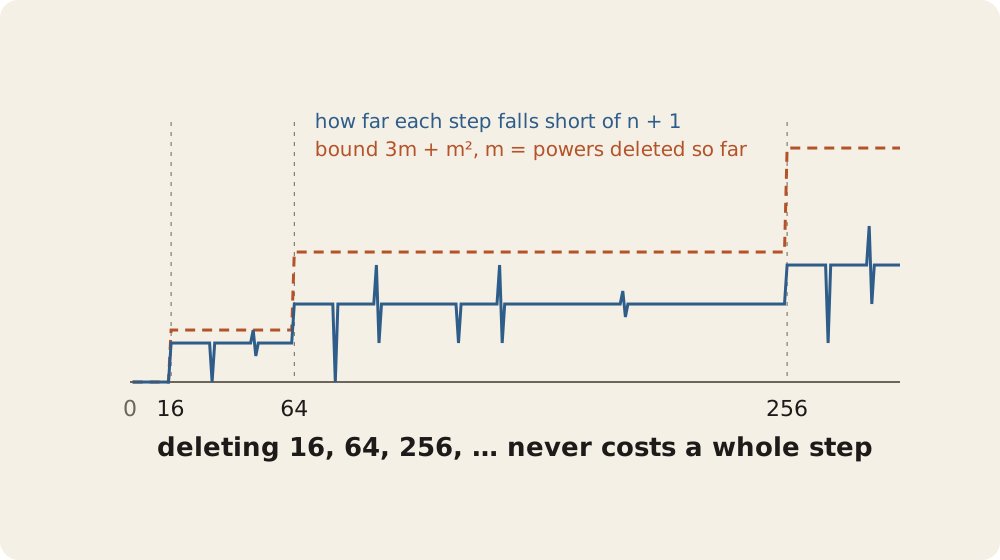
Let R_{A,h}(n) count the ordered h-tuples from a set A of natural numbers that add up to n. Sándor and Yang (arXiv:2606.28849, Remark 1.3) asked whether R_{A,h} is strictly increasing for A = ℕ ∖ {4^(j+2) : j ≥ 0}. It is, for every h ≥ 3 and from n = 0 on (Proposition 1).
Bell and Shallit’s Theorem 1 (arXiv:2212.12473) already gives strict increase for all large n, and the argument is the coefficient computation of their Theorem 2. What the note adds is the explicit bound R_{A,3}(N) − R_{A,3}(N−1) ≥ N + 1 − 3m(N) − m(N)² (Lemma 2), valid for every deleted set, with m(N) the number of deleted elements up to N, and the reduction from every h ≥ 3 to h = 3 (Lemma 3). It also records two facts about Sándor and Yang’s Problem 1.4, which asks which densities below 1 are possible: no eventually periodic set of density strictly between 0 and 1 works (Proposition 4), and any set that works has A(N)³ ≥ (N+1)(N+2)/2 (Proposition 5). A density-3/4 candidate passes an exact check up to 262,144 but is unproved (Remark 6).
Preprint v1, 9 October 2026, not peer reviewed. Lemmas 2 and 3 and Proposition 1 are formally verified in Lean 4 (lean/, standard axioms only); Propositions 4 and 5 are proved by hand. The author used AI tools (Codex, OpenAI; Claude, Anthropic) in this work, as described in the paper’s acknowledgement, and is responsible for its content.