Polyomino rectangles by parity
One copy of every hole-free n-omino tiles no rectangle for n = 8, 10 or 16, because the pieces' checkerboard imbalances add up to 2 mod 4 (for n = 16, over 11,230,003 pieces). Sizes 9 and 11 to 15 stay open.
Partial progress on an open problem
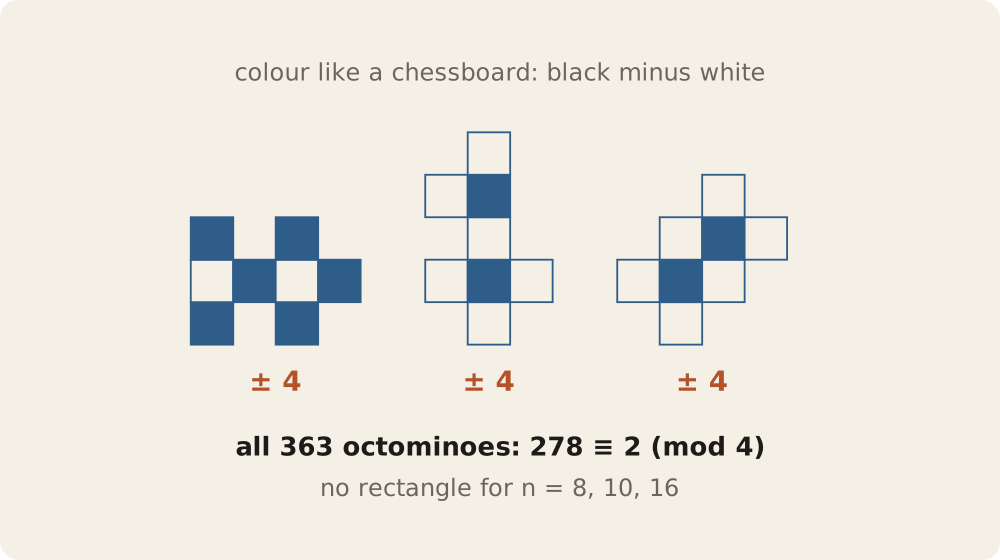
Polyomino rectangles by parity: no rectangle for 8, 10 or 16 cells
Can one copy of every hole-free n-omino tile a rectangle? On MathOverflow 378923 (Ralph Morrison, 2020) the answer is yes for n = 1, 2, 5, 7, no for n = 3, 4, 6 by a parity argument, and no for n ≥ 17 by cavity arguments in the answers (Stanley, Budd, Lehner; n = 17 by Hoffman’s computer count). The cases 8 ≤ n ≤ 16 were open.
Theorem. For n = 8, 10 and 16 the answer is no.
The reason is the checkerboard count that rules out 4 and 6. A placed piece covers ±c(P) more black than white squares; for even n every c(P) is even and the rectangle is balanced, so ∑ c(P) must be a multiple of 4. Over all hole-free n-ominoes the total S(n) is
| n | 8 | 10 | 12 | 14 | 16 |
|---|---|---|---|---|---|
| pieces | 363 | 4,460 | 58,937 | 805,475 | 11,230,003 |
| S(n) | 278 | 4,010 | 59,248 | 886,436 | 13,329,078 |
| S(n) mod 4 | 2 | 2 | 0 | 0 | 2 |
For n = 12, 14 and every odd n the count gives no obstruction, so 9, 11, 12, 13, 14, 15 remain open.
Preprint v1, 10 October 2026, not peer reviewed and not yet independently reviewed. The parity argument is formally verified in Lean 4 (lean/, standard axioms only) for any pieces and any placements; the three totals are its hypotheses, computed by two independent enumerations that both reproduce OEIS A000104, A000105 and A001168 for n ≤ 16. The author used AI tools (Claude, Anthropic) in this work, as described in the paper’s acknowledgement, and is responsible for its content.