Latin squares of small rank
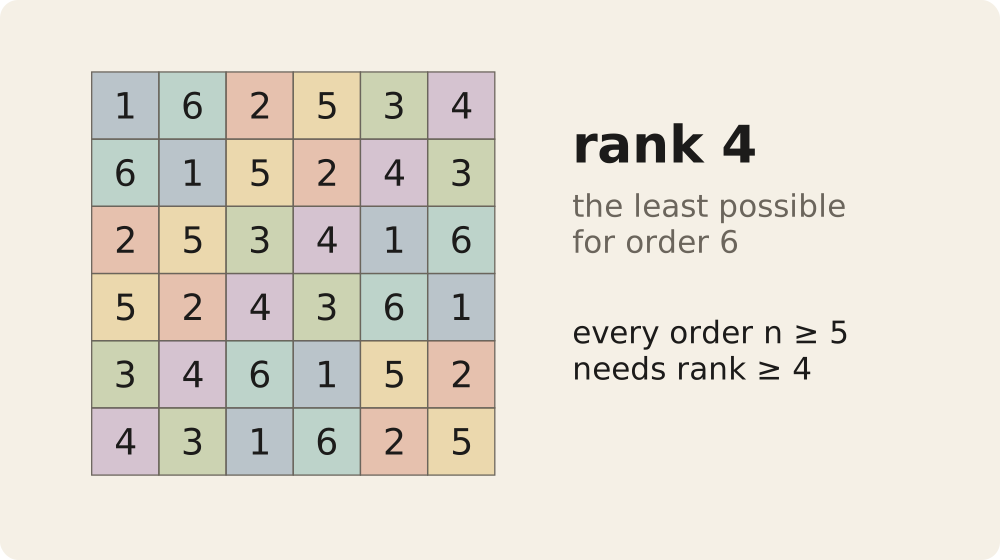
Every Latin square of order n has rank at least 1 + 3(n−1)/(n+1), so at least 4 from n = 5 on; the least ranks up to order 8 are 1, 2, 3, 3, 5, 4, 6, 4.
Partial progress on an open problem
Let r(n) be the least real rank of an n × n Latin square with entries 1, …, n. Philip Weiss asked on MathOverflow (question 515241) whether r(n) can stay bounded, and observed that the exclusive-or square gives r(2^k) ≤ k + 1.
Every Latin square of order n has rank at least 1 + 3(n−1)/(n+1), with strict inequality for odd n (Theorem 1), so r(n) ≥ 4 for all n ≥ 5. The proof writes the centred square as inner products of n row points and n column points in R^d, d = rank − 1, and applies Cauchy–Schwarz once per row. The exact values for n ≤ 8 are 1, 2, 3, 3, 5, 4, 6, 4: no Latin square of order 5 is singular. Whether r(n) is unbounded stays open; the bound cannot pass 4.
Preprint v1, 10 October 2026, not peer reviewed. Theorem 1 with its strict form, Corollary 2, and r(4) = 3, r(6) = 4, r(8) = 4 are formally verified in Lean 4 (lean/, standard axioms only). r(5) = 5 and r(7) = 6 rest on an exhaustive computation over McKay’s isotopy representatives with an exact modular certificate. The author used AI tools (Claude, Anthropic) in this work, as described in the paper’s acknowledgement, and is responsible for its content.