Unfolded cubes that tile space
Every one of the 502,110 unfoldings of the six-dimensional cube tiles five-space with its point reflection, extending Firet's five-cube result.
Partial progress on an open problem
Every unfolding of the six-dimensional cube tiles five-space
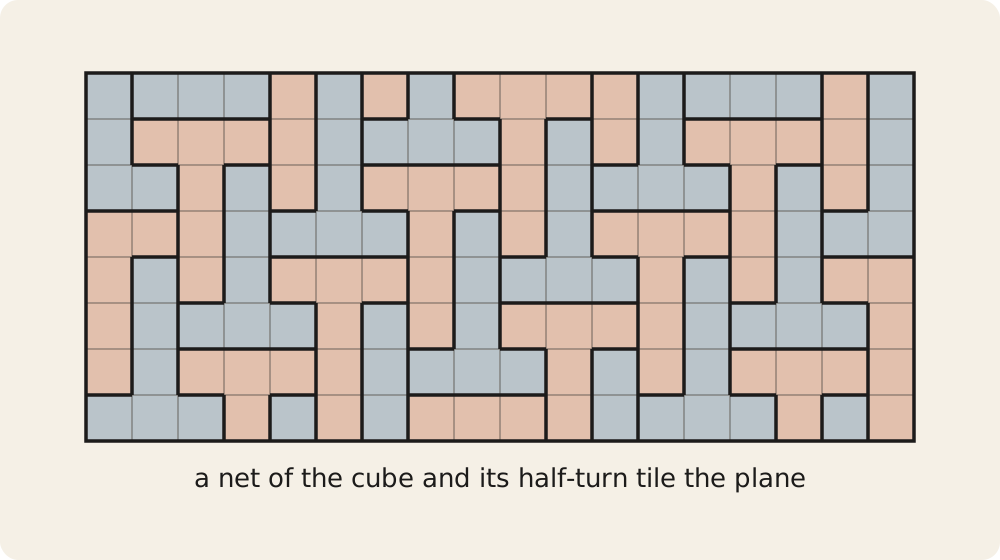
Cut the boundary of the d-dimensional cube along ridges until it unfolds flat into R^(d-1): the result is a polycube of 2d cells. The ordinary cube has 11 such nets and all of them tile the plane. Joseph O’Rourke asked on MathOverflow (question 392890) whether every unfolding of every cube tiles the space it unfolds into, and if not, up to which dimension. Moritz Firsching settled d = 4 (a/392828 to question 199097), and Jelmer Firet settled d = 5 (a/393006): each of the 9,694 unfoldings of the five-cube tiles four-space with translates of P and of its point reflection -P.
This note does d = 6. Each of the 502,110 unfoldings of the six-cube tiles five-space by translates of P and -P, one of each per period (Theorem 1), and every d <= 6 comes with an independently checked certificate. The key step is a reformulation (Lemma 5): such a tiling is the same as a homomorphism φ from Z^(d-1) onto a group G of order 4d, injective on P, with φ(P) + φ(P) ≠ G. Searching homomorphisms instead of tilings takes about an hour for d = 6 on one core. We conjecture that every unfolding of every cube tiles this way; d = 7 has 33,064,966 unfoldings.
Preprint v1, 9 October 2026, not peer reviewed. The d = 5 case is Firet’s; new here are d = 6, the rotation-only tilings for d = 4 and the lattice-tiler counts. The quotient lemmas (Lemmas 3 to 5) and Example 6 are formally verified in Lean 4 (lean/, standard axioms only); the 502,110 certificates are checked by Python programs that share no code with the search, not in Lean. The author used AI tools (Claude, Anthropic) in this work, as described in the paper’s acknowledgement, and is responsible for its content.