Catching the centroid
A circle on a random diameter of a convex region contains the centroid with probability at most 14/27 ≈ 0.5185; the equilateral triangle's 0.5164 is conjectured best.
Partial progress on an open problem
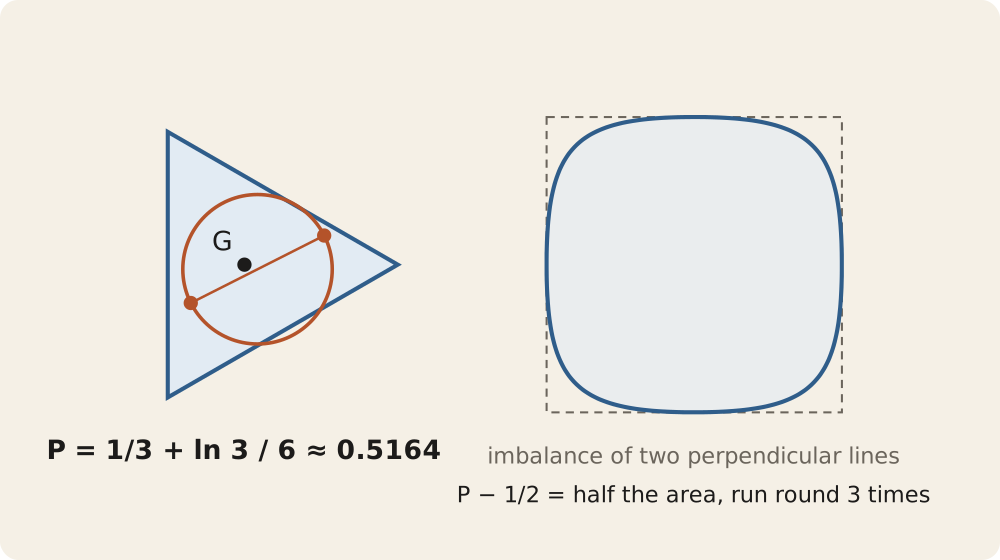
Pick two random points X and Y in a planar convex region K and draw the circle with diameter XY. Dan asked on Mathematics Stack Exchange (question 5101873) which convex shape makes this circle most likely to contain the centroid. A disc or a square gives exactly 1/2 and an equilateral triangle gives 1/3 + ln 3 / 6 ≈ 0.5164; the answers there conjecture that the equilateral triangle is best. That conjecture is still open.
The note shows that the excess over 1/2 comes only from the asymmetry of K about its centroid. In polar coordinates about the centroid, P(K) − 1/2 is the integral of the odd part of the angular density against the imbalance of the half-planes (Proposition 1), equivalently half the area swept by the imbalances of two perpendicular lines. Bounding it by the product of Grünbaum’s half-plane asymmetry and the asymmetric share 1 − s(K) of the region (Proposition 2), and using Stewart’s 1958 theorem that |K ∩ (2G − K)| ≥ (2/3)|K| at the centroid G, gives:
- Theorem 1.
|P(K) − 1/2| ≤ 1/54for every convex region, soP(K) ≤ 14/27 ≈ 0.5185, within0.0021of the conjectured value.
The note also gives a three-line proof of Stewart’s inequality from Grünbaum’s for regions whose boundary crosses its reflection through the centroid six times, which every region close to a triangle does (Lemma 1, Proposition 3), credits Levi’s older bound 2/5, and explains why 14/27 cannot reach 0.5164: both factors of Proposition 2 are affine invariants, while P is not.
Preprint v1, 10 October 2026, not peer reviewed and not yet independently reviewed. Propositions 1, 2 and 3, formula (3), Lemma 1, Theorem 1 and the bound 8/15 are formally verified in Lean 4 (lean/, standard axioms only) for continuous periodic angular densities; Grünbaum’s, Stewart’s and the Minkowski–Radon inequalities are quoted and enter as hypotheses, and the polar-coordinate formula (1) is the Lean definition of P. The author used AI tools (Claude, Anthropic) in this work, as described in the paper’s acknowledgement, and is responsible for its content.