A broken stick and a Feynman diagram
The chance that six random pieces of a stick make a tetrahedron is a three-loop Feynman diagram; it is 0.0125749944…, not 1/79.
Partial progress on an open problem
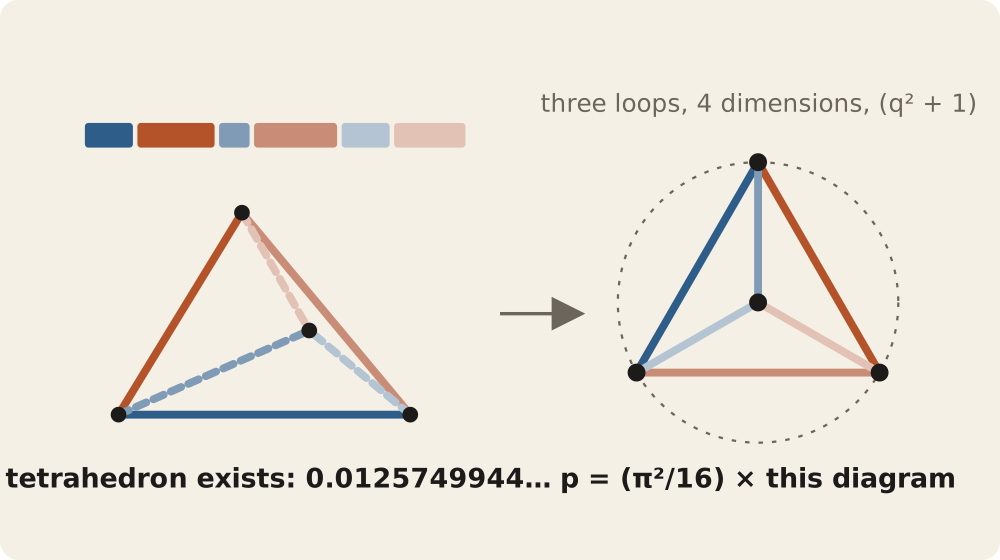
Break a stick at five random points and lay the six pieces, in a fixed order, on the edges of a tetrahedron. Benjamin Dickman asked on MathOverflow (question 142983) how often a tetrahedron with these edge lengths exists. No exact value is known, and the numbers so far were numerical estimates, one of which, 1/79, turns out to be wrong.
The note shows that the probability is a Feynman integral. For N = n(n+1)/2 pieces laid on the edges of an n-simplex,
p_n = C_n ∫ ∏ β_e^((n−2)/2) e^(−Σβ) / U(β)^((n+1)/2) dβ, C_n = 2^(N−n) π^(−N/2) Γ_n((n+1)/2),
where U is the first Symanzik polynomial of the complete graph K_{n+1} (a sum over spanning trees). So p_n is the vacuum diagram of K_{n+1} in dimension n + 1 with unit masses and every propagator raised to the power n/2:
n = 2: a one-loop triangle in three dimensions, which gives the classical1/4;n = 3: the three-loop tetrahedron in four dimensions with propagators(q² + 1)^(−3/2),p_3 = (π²/16) T;n = 4:p_4 = 1.0584 × 10^(−4)(Monte Carlo).
The route is classical step by step (exponential spacings, Schoenberg’s criterion, the Schwinger representation, Siegel’s matrix gamma integral, Kirchhoff’s matrix-tree theorem); the identity itself is new as far as a dated literature search could find. Two independent computations give p_3 = 0.0125749944167…, agreeing to within 10^(−12), which corrects the value 1/79 reported from simulation. For the question as asked, with the pieces placed in any order, the probability is 0.0652818 ± 0.0000004, consistent with an earlier estimate. No closed form is known.
Preprint v1, 10 October 2026, not peer reviewed and not yet independently reviewed. The algebra of Theorem 1 for the triangle and the tetrahedron is formally verified in Lean 4 (lean/, standard axioms only); the analytic inputs are quoted. The author used AI tools (Claude, Anthropic) in this work, as described in the paper’s acknowledgement, and is responsible for its content.