How much two balanced trees must share
Two balanced trees on n leaves always agree on at least n^0.243 leaves, and some on only n^(5/11); Martin and Thatte conjectured n^(1/2).
Partial progress on an open problem
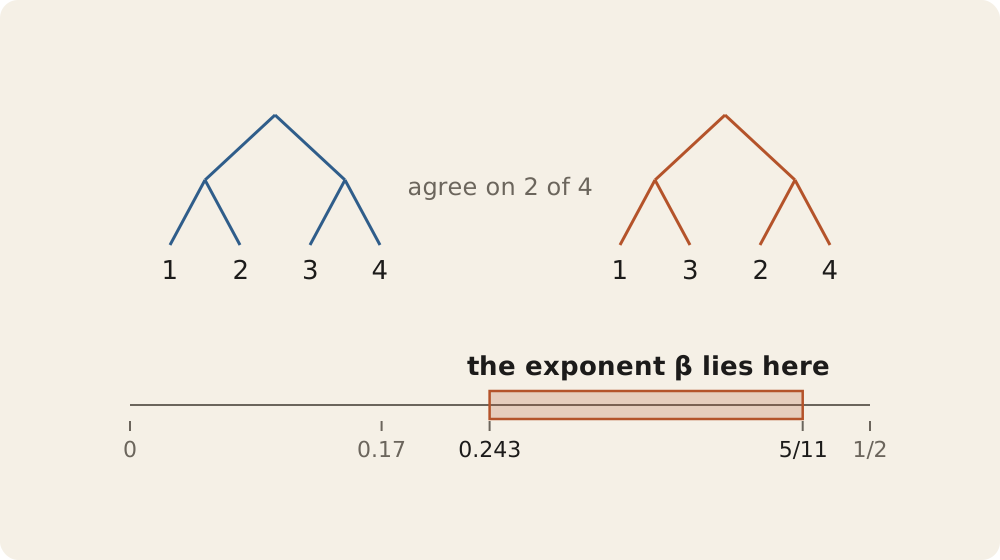
Agreement subtrees of balanced trees
Two rooted binary trees on the same leaf labels agree on a set of labels when the subtrees they induce on
it are the same. Let M(n) be the least possible size of the largest such set over all pairs of
balanced trees on n = 2^m leaves. Martin and Thatte conjectured M(n) ≥ √n; Bordewich, Linz, Owen,
St. John, Semple and Wicke (SIAM J. Discrete Math. 2022) disproved it by a slowly vanishing factor and
proved M(n) ≥ n^0.17.
The paper proves:
- The exponent exists. A substitution lemma makes
Msubmultiplicative, so by Fekete’s lemmaβ = lim log₂ M(2^m) / mexists and equals the infimum. Any single pair of balanced trees therefore gives a bound for alln. β ≤ 5/11. Thek = 3example of Bordewich et al. (2048 leaves, agreement 32) givesM(n) ≤ 2^10 n^(5/11), polynomially below√n.β ≥ 0.243. Their inductive lower bound with optimised constants givesn^0.235; an induction that looks two levels down one tree and one level down the other givesn^0.243.
Preprint v1, 9 October 2026, not peer reviewed.
- Formally verified in Lean 4 (
lean/, standard axioms only):- the substitution lemma, submultiplicativity and the existence of the exponent;
- Lemma 4.5 of Bordewich et al. and an explicit 2048-leaf pair with agreement at most 32, hence
β ≤ 5/11; M(n) ≥ n^0.235, including its computer-assisted inequality (Lean checks a certificate);- the two-level induction, giving
M(n) ≥ n^0.243from the inequality of Lemma 5.3; - that agreement through triples is the usual definition (
S|Y ≅ T|Y).
- Not formalised: the inequality of Lemma 5.3. Its certificate (1,418,968 simplices) is checked in
exact arithmetic by
verify/certify_simplex_rig.py. Son^0.243rests on that program, whilen^0.235and5/11are fully machine-checked.
The author used an AI assistant (Claude, Anthropic) in this work, as described in the paper’s acknowledgement, and is responsible for its content.