Almost-squares in almost-squares
Which k × (k+1) rectangles split into smaller distinct ones: exactly 4, 10, 12, 14, 15, 18 and every k ≥ 20. Friedman's conjecture.
Open problem settled, formally verified in Lean 4
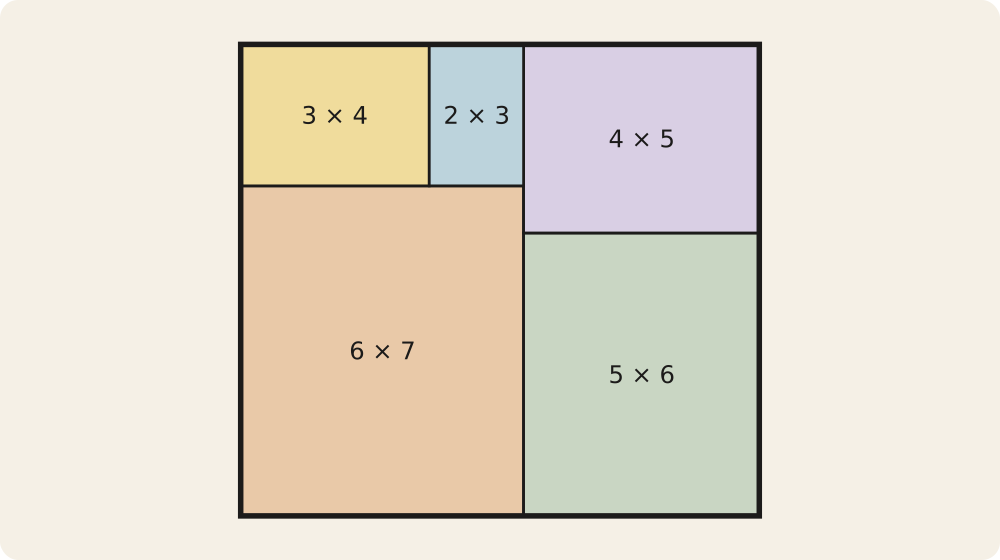
Tiling almost-squares with smaller distinct almost-squares
An almost-square is a k × (k+1) rectangle. Erich Friedman asked for which n the n × (n+1) almost-square can be cut into almost-squares of distinct sizes, all smaller than n (Math Magic, Problem of the Month, May 2012), and conjectured that every n ≥ 20 works.
The answer: exactly when n ∈ {4, 10, 12, 14, 15, 18} or n ≥ 20 (Theorem 1). The construction scales a perfect squared square and moves each cut line by an integer so that every square becomes an almost-square; one counting identity proves it correct and gives a parity lemma explaining why the squared square of side 112 reaches only even n and the one of side 110 only odd n. Explicit tilings cover the remaining n from 20 to 248, and an exhaustive search settles n ≤ 19.
Preprint v1, 8 October 2026, not peer reviewed; the exposition has not yet been independently reviewed. Friedman’s list of solved problems credits the result. The author used an AI tool (Claude, Anthropic) in this work, as described in the paper’s acknowledgements, and is responsible for its content.