Library · The Riddler · Chapter 67
Can You Hop Across The Chess Board?
Riddler Express
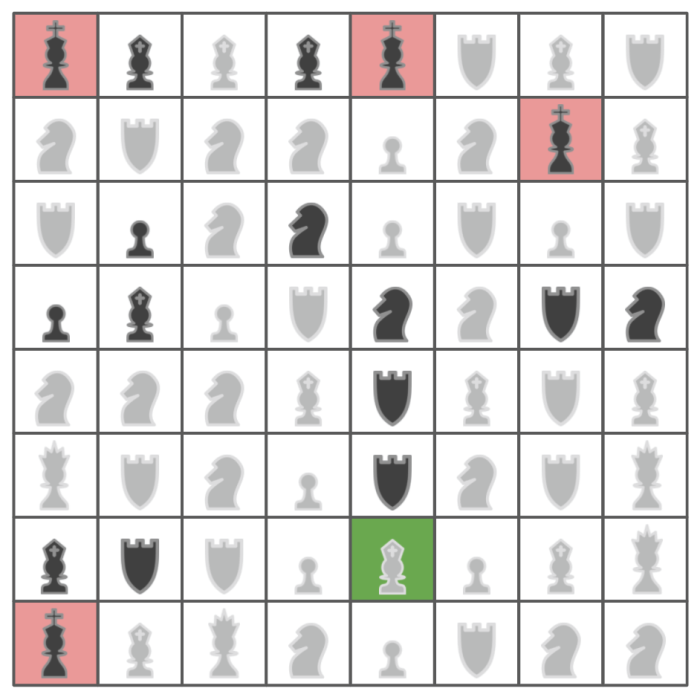
An board holds one chess piece per square. Starting on the white bishop (the green square), move from white piece to white piece according to each piece’s move (pawn: one step diagonally up; knight: an L; bishop: one diagonal step; rook: one orthogonal step; queen: one step any direction), never landing on a black piece other than a king. Reach a black king.
Solution
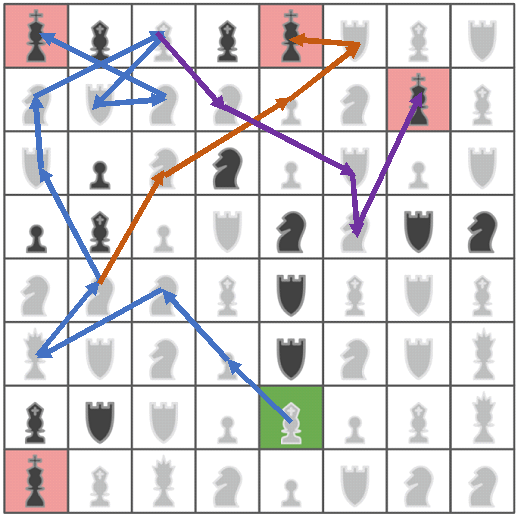
Make the board a directed graph: each square is a node, with an arrow to every square its piece can legally step to, but only if that destination is a white piece or a black king (so the walk never touches a forbidden black piece). The puzzle becomes a path-finding problem, and a shortest-path search from the green bishop reaches a black king in eight moves. Writing squares as (column, row) with row at the bottom, one such route is that is bishop pawn knight queen knight knight pawn rook king, ending on the black king at , as traced below.
The computation
Build the directed graph from the board, adding an edge only when the destination is white or a black king, then take the shortest path from the start to any king.
import networkx as nx
def moves(piece, i, j, n=8):
    M = {"p": [(i+1,j+1),(i-1,j+1)],
         "b": [(i+1,j+1),(i-1,j+1),(i-1,j-1),(i+1,j-1)],
         "r": [(i,j+1),(i-1,j),(i+1,j),(i,j-1)],
         "h": [(i-1,j+2),(i+1,j+2),(i-1,j-2),(i+1,j-2),
               (i-2,j-1),(i-2,j+1),(i+2,j-1),(i+2,j+1)],
         "q": [(i,j+1),(i-1,j),(i+1,j),(i,j-1),(i+1,j+1),
               (i-1,j+1),(i-1,j-1),(i+1,j-1)]}
    return [(a, b) for a, b in M[piece] if 0 <= a < n and 0 <= b < n]
def solve(board, start, kings):
    cell = {}
    for i, row in enumerate(reversed(board)):
        for j, pc in enumerate(row): cell[(j, i)] = pc
    G = nx.DiGraph()
    for (i, j), pc in cell.items():
        if pc[0] == "w":
            for m in moves(pc[1], i, j):
                if cell[m][0] == "w" or cell[m] == "bk": G.add_edge((i, j), m)
    reachable = [k for k in kings if k in G and nx.has_path(G, start, k)]
    return min((nx.shortest_path(G, start, k) for k in reachable), key=len)
board = [["bk","bb","wb","bb","bk","wr","wb","wr"],
         ["wh","wr","wh","wh","wp","wh","bk","wb"],
         ["wr","bp","wh","bh","wp","wr","wp","wr"],
         ["bp","bb","wp","wr","bh","wh","br","bh"],
         ["wh","wh","wh","wb","br","wb","wr","wb"],
         ["wq","wr","wh","wp","br","wh","wr","wq"],
         ["bb","br","wr","wp","wb","wp","wb","wq"],
         ["bk","wb","wq","wh","wp","wr","wh","wh"]]
print(solve(board, (4, 1), [(0,0),(0,7),(4,7),(6,6)]))
Riddler Classic
Climbing holds are dropped at uniformly random heights on a -metre wall until there is no vertical gap larger than metre (counting the floor and the top). How many holds, on average? Extra credit: on a wall where any two holds (or a hold and an edge) must be within metre to connect, how many until the bottom links to the top?
Solution
Both versions are settled by running the actual placement process: drop holds at random and stop the moment the wall becomes climbable. In one dimension a hold sits at a uniform height in , and we keep adding until every gap between neighbouring holds (and to the two ends) is at most . Simulating many walls, the average count settles near For the two-dimensional wall, two holds connect when they are within metre, the floor connects to any hold within metre of the bottom edge and likewise the top, and we stop once a connected chain of holds joins bottom to top. Tracking the growing clusters with a union-find structure, the average is far higher, because a two-dimensional barrier is much harder to bridge than a single vertical line.
The computation
Simulate the placement directly. In one dimension, insert random heights until the largest gap drops to ; in two dimensions, union each new hold with every hold (and edge) within range and stop when bottom and top join.
import bisect, math
import numpy as np
from networkx.utils.union_find import UnionFind
rng = np.random.default_rng(0)
def climb_1d(H=10.0, d=1.0, runs=20_000):
    total = 0
    for _ in range(runs):
        pts = [0.0, H]
        while max(b - a for a, b in zip(pts, pts[1:])) > d:
            bisect.insort(pts, rng.uniform(0, H))
        total += len(pts) - 2
    return total / runs
def climb_2d(H=10.0, d=1.0, runs=400):
    total = 0
    for _ in range(runs):
        holds = {1: (0, 0), 2: (0, H)}; cnt = 2     # 1 = floor, 2 = top
        uf = UnionFind(); uf.union(1); uf.union(2)
        while uf[1] != uf[2]:
            cnt += 1; nh = (rng.uniform(0, H), rng.uniform(0, H))
            for i, h in holds.items():
                near = abs(h[1] - nh[1]) <= d if i in (1, 2) else math.dist(h, nh) <= d
                if near: uf.union(i, cnt)
            uf.union(cnt); holds[cnt] = nh
        total += cnt - 2
    return total / runs
print(climb_1d(), climb_2d())                  # ~43, ~143