L-Panel
L-Panel is the puzzle of tiling with bent pieces. The grid is a rectangle of white cells interrupted by an irregular scattering of black cells. The solver covers every white cell with L-shaped tetrominoes, each occupying exactly four cells in one of eight orientations (four rotations of the L-tetromino and their four mirror images, equivalently the L- and J-tetrominoes of Tetris). No tile may overlap another, no tile may cross a black cell, and no white cell may be left uncovered.
L-Panel is a pure exact-cover puzzle. Unlike the shading and line-drawing puzzles elsewhere in this volume, there are no numeric clues to satisfy and no symmetry conditions to obey: the black cells alone determine the geometry, and the solver’s task is to jigsaw the remaining white region into L-tiles. The puzzle rewards patience with pattern-recognition over calculation, and it is particularly satisfying to watch a constraint solver reduce it to a single integer-programming expression and return the tiling in a few milliseconds.
The L-tetromino (also called the “L-piece”) is one of the seven one-sided tetrominoes studied in mathematical recreational theory. Every connected region with area divisible by four is L-tileable provided its shape is not too pathological, but deciding tileability of an arbitrary region is NP-hard in general (Moore and Robson, ); L-Panel instances are hand-designed so that the black-cell scaffolding leaves a uniquely tileable white region.
Rules and a small instance
An L-Panel puzzle is an grid of cells, each either white or black. The number of white cells must be divisible by four. A solution is a set of L-tetrominoes (any of the eight orientations) such that:
Every white cell belongs to exactly one tile.
No tile covers a black cell.
No two tiles overlap.
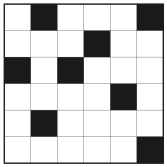
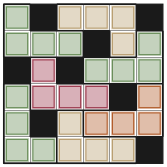
Figure 21.1 is a L-Panel with eight black cells. The remaining white cells partition uniquely into L-tiles.
The programming model
The model is the textbook exact-cover formulation.
Candidate tiles
Enumerate the eight orientations of the L-tetromino as lists of offsets: For every cell of the grid and every shape , form the placement Retain as a candidate tile if all four of its cells lie inside the grid and none is black. Let denote the resulting set of candidate tiles (as frozensets, to deduplicate placements of the same tile encountered via different anchor cells).
Exact cover
Introduce a Boolean variable for each , with meaning “tile is selected.” For every white cell , This is a classical exact-cover constraint: the -by- incidence matrix has row sum equal to in every white-cell row. The constraint is tight: if a white cell is covered by zero tiles, it is uncovered (forbidden); if it is covered by two or more tiles, they overlap (forbidden).
No explicit overlap constraint is needed, because the exact-cover condition on every white cell implies that every chosen tile’s four cells are each covered by exactly that tile and no other.
A CP-SAT solver
from ortools.sat.python import cp_model
from collections import defaultdict

L_SHAPES = [
    [(0,0),(1,0),(2,0),(2,1)],
    [(0,0),(0,1),(0,2),(1,2)],
    [(0,1),(1,1),(2,1),(2,0)],
    [(1,0),(1,1),(1,2),(0,0)],
    [(1,0),(1,1),(1,2),(0,2)],
    [(0,0),(0,1),(1,0),(2,0)],
    [(0,0),(0,1),(1,1),(2,1)],
    [(0,0),(1,0),(0,1),(0,2)],
]

def solve_lpanel(board):
    R, C = len(board), len(board[0])
    polys = set()
    for r in range(R):
        for c in range(C):
            for sh in L_SHAPES:
                p = frozenset(
                    (r+dr, c+dc) for dr, dc in sh)
                if all(0 <= pr < R and 0 <= pc < C
                        and board[pr][pc] != -1
                       for pr, pc in p):
                    polys.add(p)
    m = cp_model.CpModel()
    t = {p: m.NewBoolVar("") for p in polys}
    cell_to_polys = defaultdict(list)
    for p in polys:
        for cell in p:
            cell_to_polys[cell].append(p)
    for r in range(R):
        for c in range(C):
            if board[r][c] != -1:
                m.Add(sum(t[p]
                           for p in cell_to_polys[(r, c)])
                      == 1)
    s = cp_model.CpSolver()
    status = s.Solve(m)
    if status not in (cp_model.OPTIMAL, cp_model.FEASIBLE):
        raise RuntimeError(
            "no solution: " + s.StatusName(status))
    return [p for p in polys if s.Value(t[p])]
The toy of Figure 21.1 solves uniquely in about milliseconds.
A hard instance
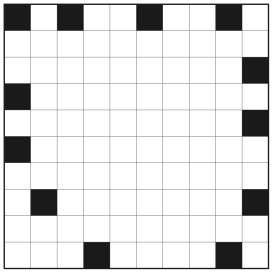
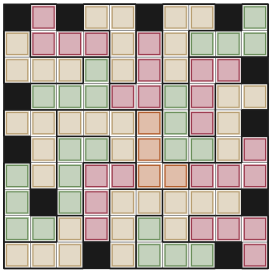
Figure 21.3 is a L-Panel in the instance of Alex Bellos’s Puzzle Ninja, puzzle : twelve black cells scatter the interior, leaving white cells (exactly L-tiles) for the solver. CP-SAT returns the unique tiling in about milliseconds.
Sources. L-Panel appears in Alex Bellos’s Puzzle Ninja: Pit Your Wits Against the Japanese Puzzle Masters (Guardian Faber, ), where it is credited to Japanese pencil-puzzle tradition. The hard instance of Figure 21.3 is puzzle from that collection. The exact-cover formulation used here is due to Dancing Links (Knuth, ), though CP-SAT propagates the same logic via row-sum unit constraints; Knuth’s DLX algorithm remains the canonical exact-cover tool for hand-tuned enumeration. Tiling a region by L-tetrominoes is NP-hard in general (Moore and Robson, ).