Chess Capture Digraphs
Erich Friedman asked which directed graphs arise when an arrow runs from each chess piece to every piece it attacks. Here is a position for digraph u, which his answers page lists as having none, and smaller boards for digraphs h, k and l.
The rules
In his Math Magic column for October 2013, Erich Friedman asked which directed graphs can be drawn by chess pieces on a board, one piece for each point, following these rules.
- The pieces are kings, queens, rooks, bishops and knights, with no pawns. Any number of each may be used.
- Colour is ignored, so any piece can attack any other.
- There is an arrow from one piece to another exactly when the first attacks the second: every attack is an arrow and every arrow is an attack.
- A piece attacks another if it could move to that square in one move. So a rook, bishop or queen attacks only the first piece in each direction, and a king or knight cannot be blocked.
- In these digraphs each piece attacks exactly two others and is attacked by exactly two.
- The board may be any rectangle, and the aim is the smallest area.
In each figure below, the digraph is drawn as on Friedman’s page, with the piece and its square at each point.
Digraph u
Friedman’s answers page lists digraph u as having no position (as of 27 September 2026). It has one, on a board of twelve squares, and no smaller board works.
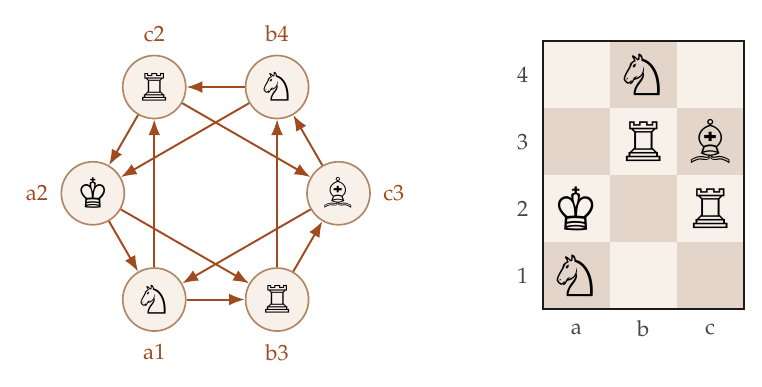
Each piece attacks exactly two others. The rook on c2 attacks the bishop on c3 and the king on a2. The knight on b4 attacks the rook on c2 and the king. The bishop attacks both knights. The rook on b3 attacks the knight on b4 and the bishop. The knight on a1 attacks both rooks. The king attacks the rook on b3 and the knight on a1.
Smaller boards for h, k and l
Friedman’s page already has positions for digraphs h, k and l, on boards of 16, 15 and 16 squares. Each also fits on a 3 × 4 board.
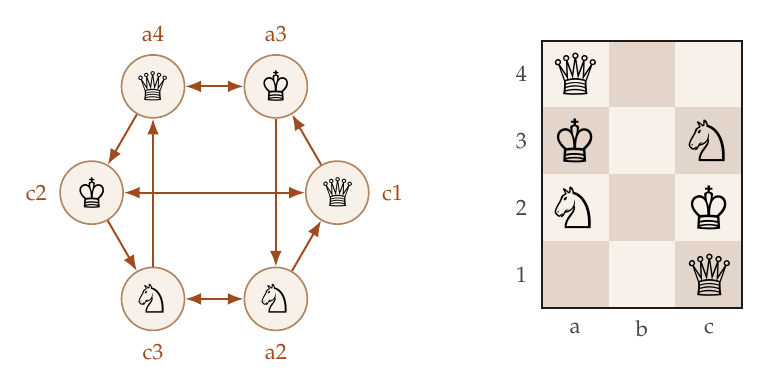
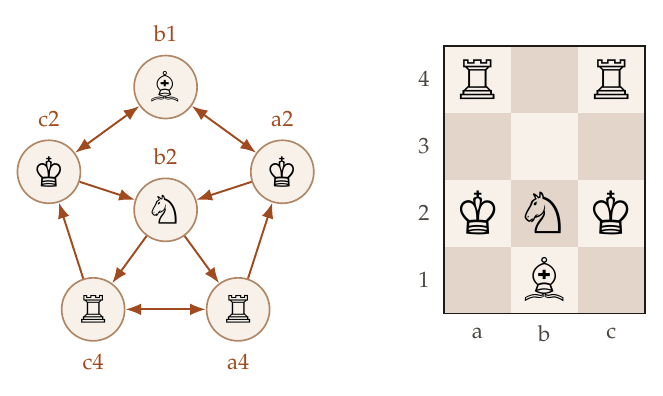
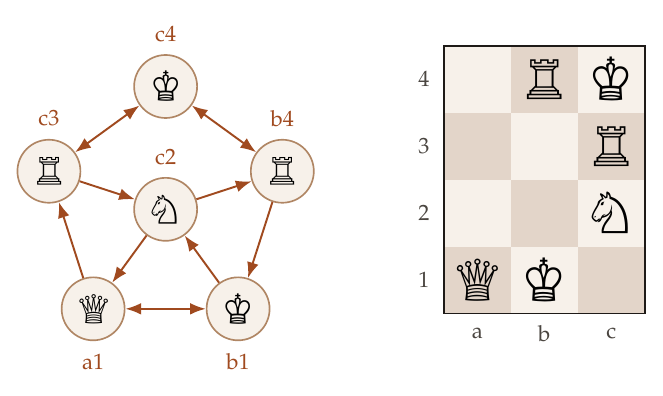
The positions were found on 27 September 2026 with an AI-assisted search. Each was checked square by square against its digraph by a separate program, and the board for u against every smaller board.